How the Wherigo Player Works
A picture of every screen in the player, and what each part of it does.
A Wherigo cartridge is a game you play by walking. It watches where you are and reacts when you reach the places it cares about: it shows you things, gives you things, asks you questions, and at the end it hands you a completion code. This page shows what each part of the player does, so you can see the whole thing before you are standing outside with one running.
Everything runs on your device. The cartridge file is never uploaded, and your progress is saved where you played it.
Starting a cartridge
The player opens on its Library, one of four tabs. Open is where a new cartridge comes in: tap to choose a .gwc file, or drop one on it on a computer. If you have never played a Wherigo before, try the example cartridge there: it is a short game set on Liberty Island that you can walk through from your chair.
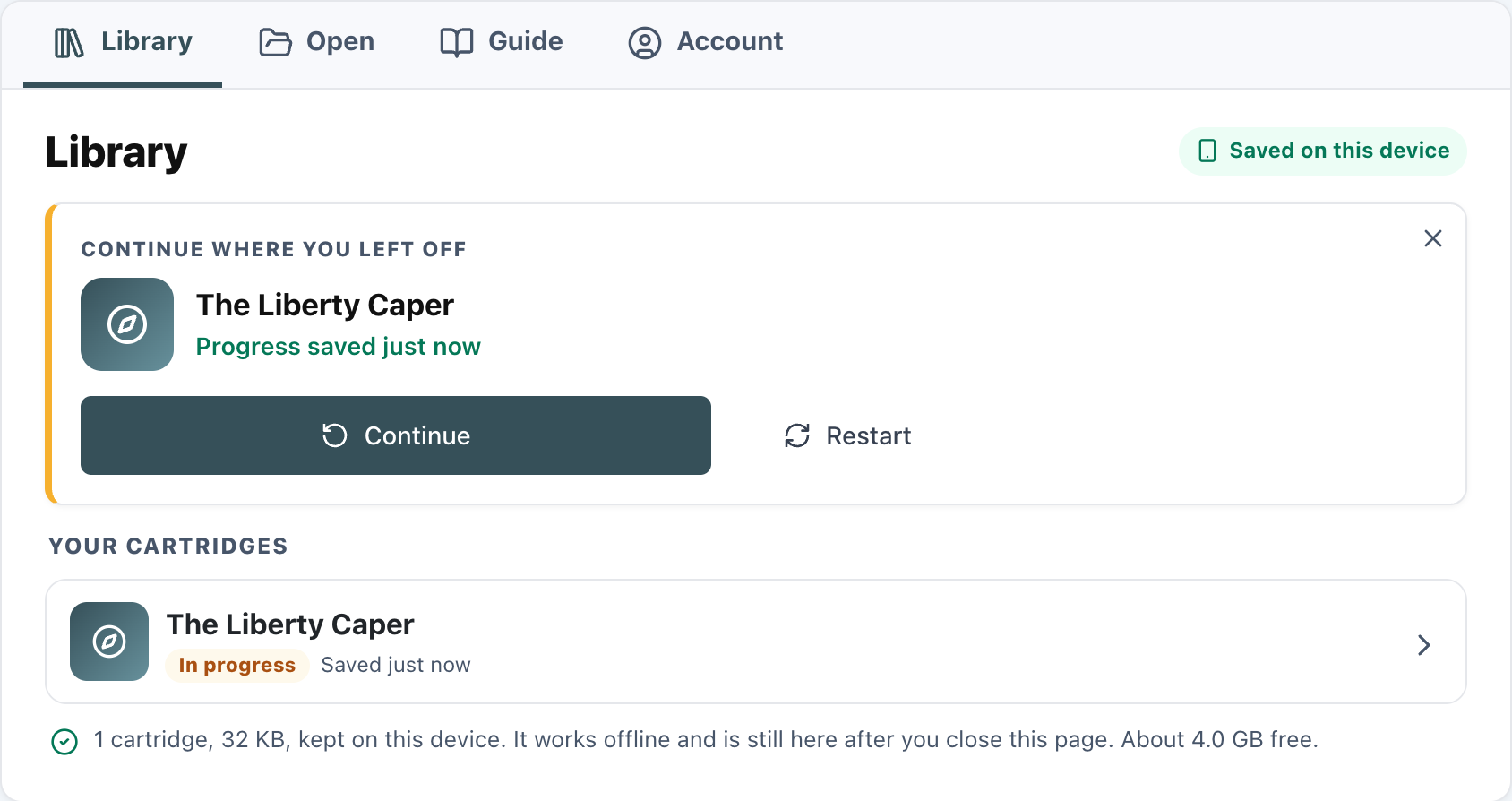
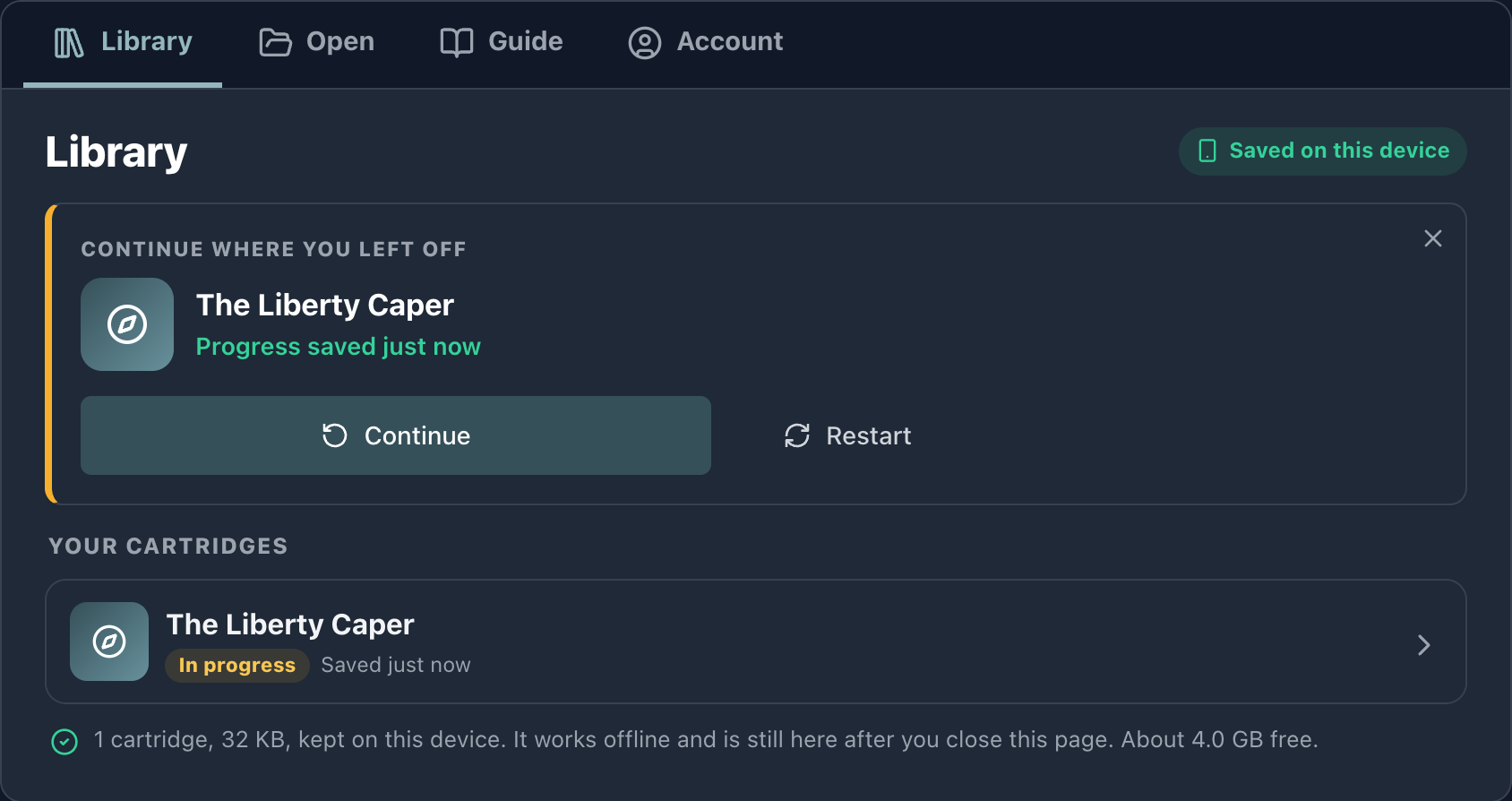
- Cartridges you have opened stay on the device, in the Library, so the next time you come back you do not need the file picker again. Each one says where it stands: in progress and when it was last saved, when you last played it, or not started yet.
- A game you left unfinished is pinned at the top as Continue where you left off, one tap from where you stopped. Done with that game? The X in its corner dismisses the card, and it stays away until you make new progress somewhere.
- Tapping a cartridge shows you its name, description, starting location and saved progress first. Nothing runs until you press Start, or Resume for a game in progress. Remove from library is there too, and it leaves the saved game alone.
- Guide carries this guide inside the player, so it works with no signal, and Account is where you sign in to carry your cartridges to another device.
The screen you play on
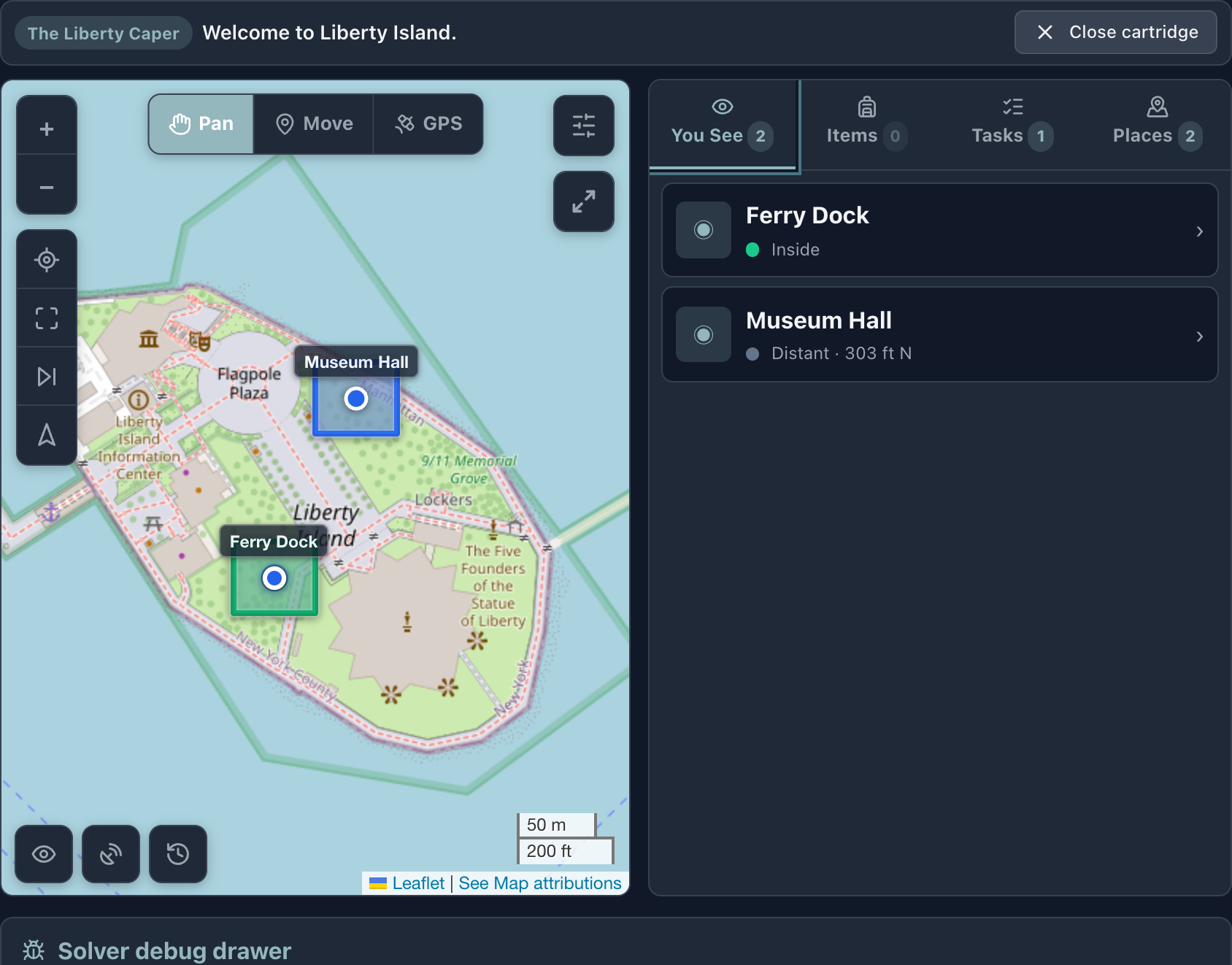
Once a cartridge is running, the map is on the left and everything the cartridge has given you is on the right. The nine numbers below are on the picture and in the list under it.
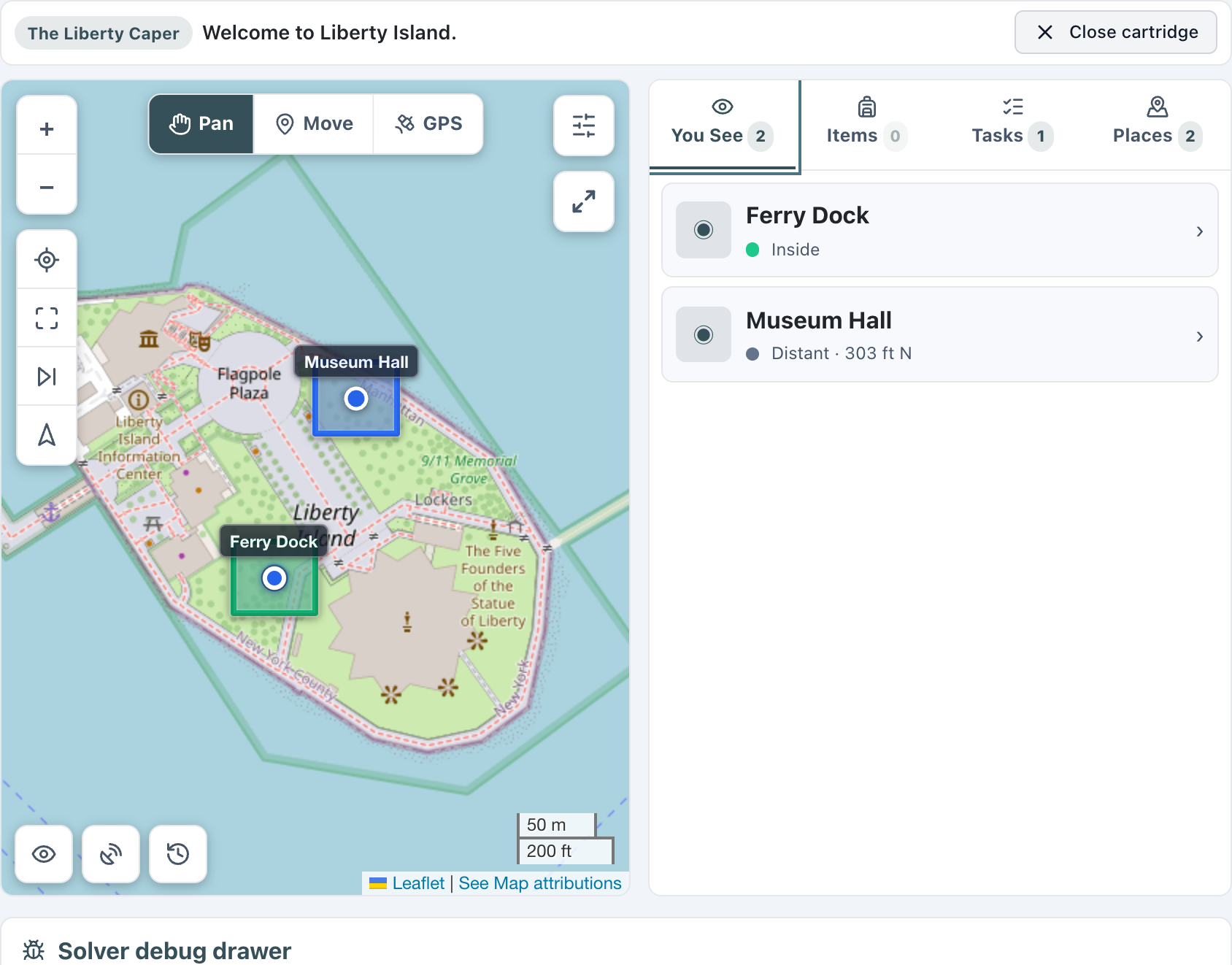
- 1The cartridge. Which game is running. It is the first thing to check when you come back to a player you left open.
- 2What the cartridge is telling you. This line is the cartridge talking to you: how far the next place is, and what just happened. Anything that needs an answer opens on top of the map instead.
- 3The places you walk to. Zones the cartridge has switched on are drawn here, with your own position as the blue dot. A zone appears only when the cartridge reveals it, so a nearly empty map early in a game is normal.
- 4Walking, or trying it from your chair. GPS follows your real position, which is the one you want in the field. Move lets you tap the map to put yourself somewhere, so you can try a cartridge at home. Pan scrolls the map without moving you at all.
- 5Finding your way. Center the map on yourself, fit everything on screen, jump to the next zone, or lock the map so it follows you as you walk.
- 6Map tools. Three buttons in the bottom left corner of the map. The eye shows the zones the cartridge is keeping hidden, which is a solver's view rather than a player's: they come in as one plain dashed gray shape, with the state color only on the small pin at their center, so they never read as a zone the cartridge has actually revealed. The satellite mark turns on the coordinates you are standing on, which appear just above as a button you tap to copy. They are off until you ask for them, because most of the time nobody is reading coordinates and they sat over the map's own credit line. The clock opens What you have done, described further down.
- 7Settings. How to play, restarting the cartridge, your trail, the basemap, distance units, vibration and an offline map to take with you all live behind this button. The arrows just under it throw the map full screen, and on a phone the player is already full screen so they are not there.
- 8You See, Items, Tasks, Places. Everything the cartridge has given you. You See is what is around you right now, Items is what you are carrying, Tasks is what to do next, and Places lists the zones with their distances. The number on each tab is how much is in it. Tapping a place opens its description, with View on map to see where it sits among the others and Navigate to this place to walk there.
- 9Close (the X). Takes you back to the Library. Your progress is saved first, so you can pick the same game up later from Continue where you left off.
When the cartridge talks to you
Messages, questions and choices arrive on top of the map. A cartridge usually says hello the moment it starts, so the first thing you see after pressing Start is one of these rather than the map. Read it, answer it, and the map is underneath.
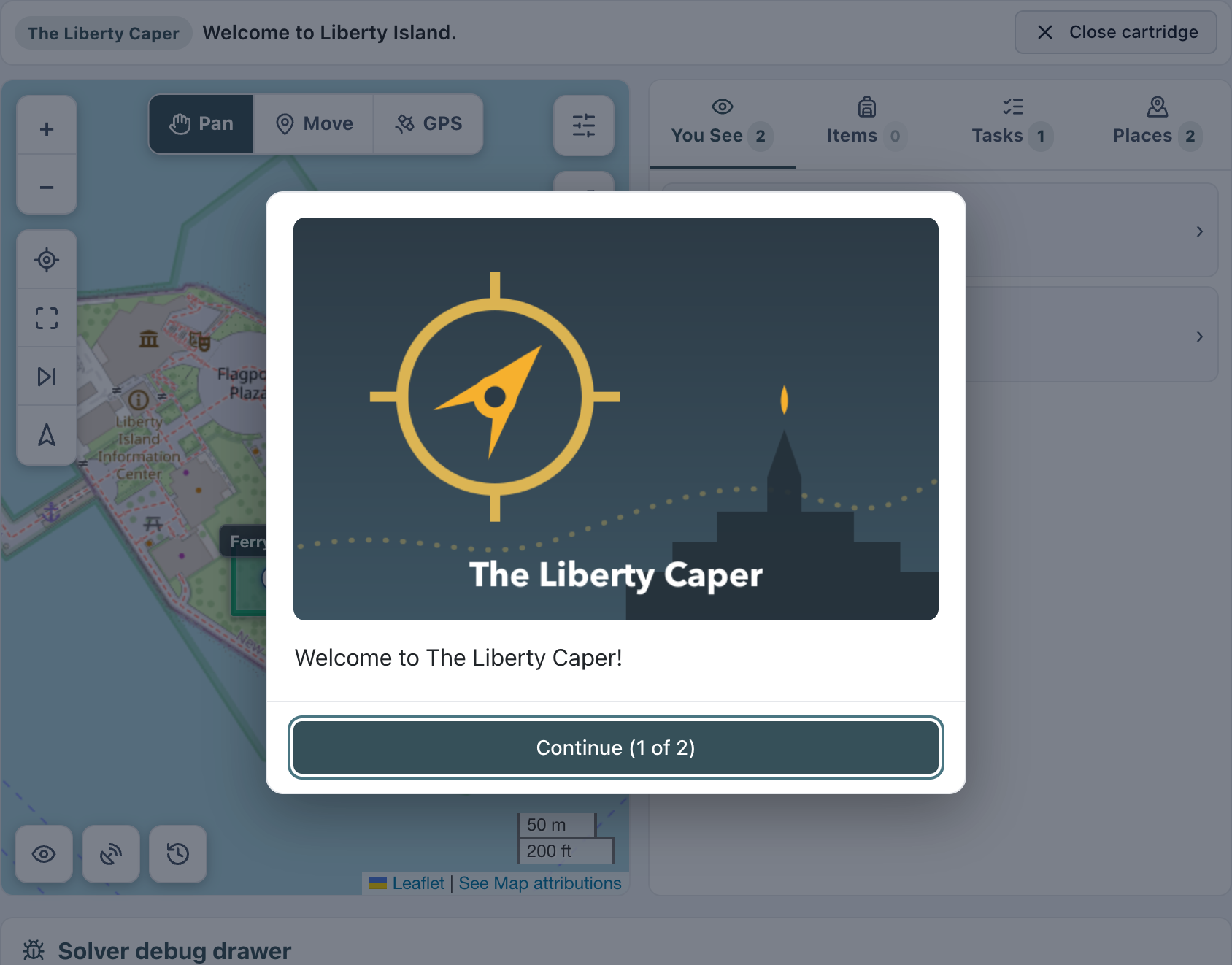
- A message that is part of a run of several counts itself, so you know how many are left.
- Messages carry the cartridge's own pictures, so an author who drew a title card, a character or a clue can put it in front of you.
- A question waits for you. Nothing in the game moves on until you answer it.
- Some cartridges ask your phone for your attention outright. When one does, the player beeps and buzzes, so it reaches you with the phone in a pocket.
- Some cartridges ask you to type an answer, and some give you a list to pick from. Both arrive the same way.
- When the dialogs finish and something new is standing where you are, a character to talk to or an item to pick up, a small note appears: The Field Tester is here. Open the You See tab. Tap the note and you are there. Cartridges hang their next step on these, so the player makes sure you never miss one behind the map.
On a phone, out in the field
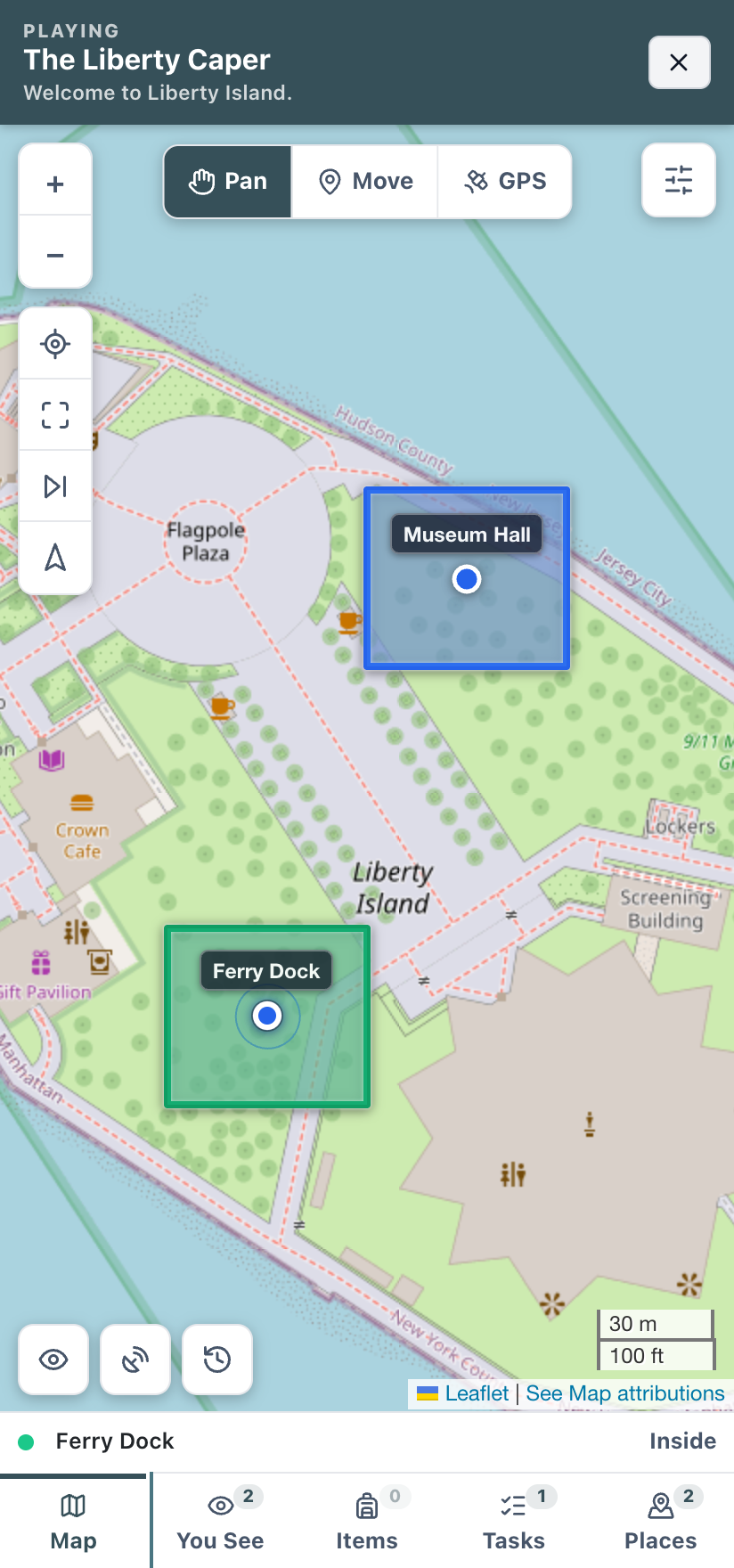
- The player takes the whole screen and becomes five tabs on a rail along the bottom, where your thumb is: Map, You See, Items, Tasks and Places. Each one fills the screen on its own, so the map is a full screen map and a list is a full screen list.
- A game opens on the Map tab. Tap a list tab to read something, then tap Map to get back to walking.
- The line at the foot of the map is the place you are nearest, and how far away it is or that you are standing in it. Tap it to open the Places tab.
- The three buttons in the bottom left corner of the map are the same ones a big screen gets: the eye for hidden zones, the satellite mark that turns the coordinates on, and the clock for what you have done. They are sized for a thumb.
- A faint dashed line follows you around the map: that is your trail, where you have already been. It is drawn under the zones so it never hides one, and you can turn it off in Settings.
- The arrow in the top right corner ejects the cartridge, saving as it goes. You never have to go looking for the way out.
- Switch to GPS before you set off. The player asks for your location the first time, keeps the screen awake while a game is running, and re-checks every zone as you move.
- Take the map with you: Settings has an offline map you can download for the area a cartridge covers, for the caches that are out of signal.
- If you play often, install it. There is a real app for both phones, and the section below says which is which.
On an iPhone, and on Android
Everything above works in the phone's browser, and for a cartridge or two that is enough. The app is called Waypost, it is the same player, and it adds the three things a browser tab cannot do: your phone treats a .gwc file as something it knows how to open, the whole player ships inside the app so it starts with no signal at all, and a cartridge keeps running with the phone in your pocket.
iPhone and iPad
Waypost is in open beta on TestFlight, Apple's own app for trying apps before they are on the App Store. iOS 15 or newer. Nothing is sideloaded and nothing has to be trusted by hand.
- Opening a .gwc from Files, Mail or a share sheet loads it straight into the player.
- Starting a game asks for your location once, and nothing else. Later, the first time you pocket the phone mid-game, it offers to keep playing in your pocket. Say yes and iOS asks for Always location, and only then for notifications, so an arrival can reach you with the screen off.
- Zones you arrive at buzz the phone and raise a notification, so a cartridge that has been waiting for you does not go unnoticed.
Android
Waypost for Android is a download from this site rather than the Play Store, so Android checks with you twice while installing it. Android 7 or newer.
- Tapping a .gwc in your downloads, or sharing one from a chat, opens it in the player.
- Location is granted the way any app asks for it, and a game keeps the screen awake while you walk.
- The player inside the app updates itself, so fixes arrive without a download. Now and then the app around it offers an update of its own.
Not ready to install anything? On either phone, open the player in your browser and add it to the home screen. You get the same player, the same offline play and the same cartridge library in its own window. Only the file handling and the pocket play are app specific.
Walking to one place
Open a place from the Places tab and press Navigate to this place for a full-screen walk to exactly one zone. It turns GPS on for you, and you choose how to be guided: a compass arrow that points the way, or this map view with a dashed line from you to the target.
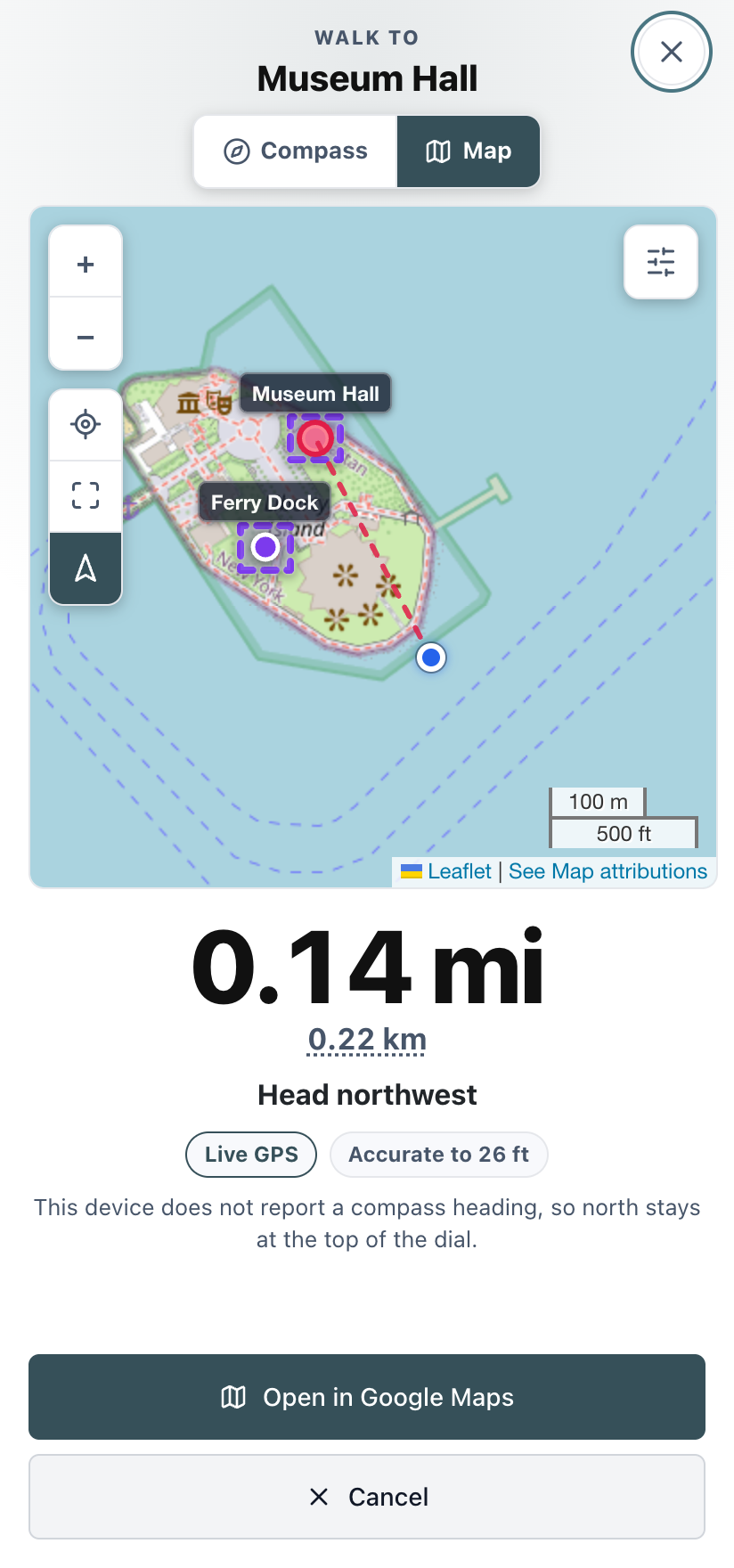
- The big number is the distance left, in your units, with the other units under it. Below that, which way to set off. Tap either number to swap the whole player between feet and meters.
- Far out it counts down in miles or kilometers, and inside a tenth of a mile it switches to feet, which is the point where the number stops being something to drive by and starts being something to pace out.
- Compass and Map are two views of the same walk: switch freely, the player remembers which one you prefer.
- This screen is for real walking, so the map's jump-to-the-next-zone button is put away here. Your feet move the blue dot.
- The chips under the distance show the GPS state and how accurate the fix is right now.
- Rather follow turn-by-turn directions? The button at the foot hands the destination to your phone's own maps app.
- Stepping into the zone ends the walk by itself, and whatever the cartridge does on arrival is the next thing you see. Cancel backs out and puts your movement mode back the way it was.
Settings
The button above the map opens everything about how the player looks and what it draws.
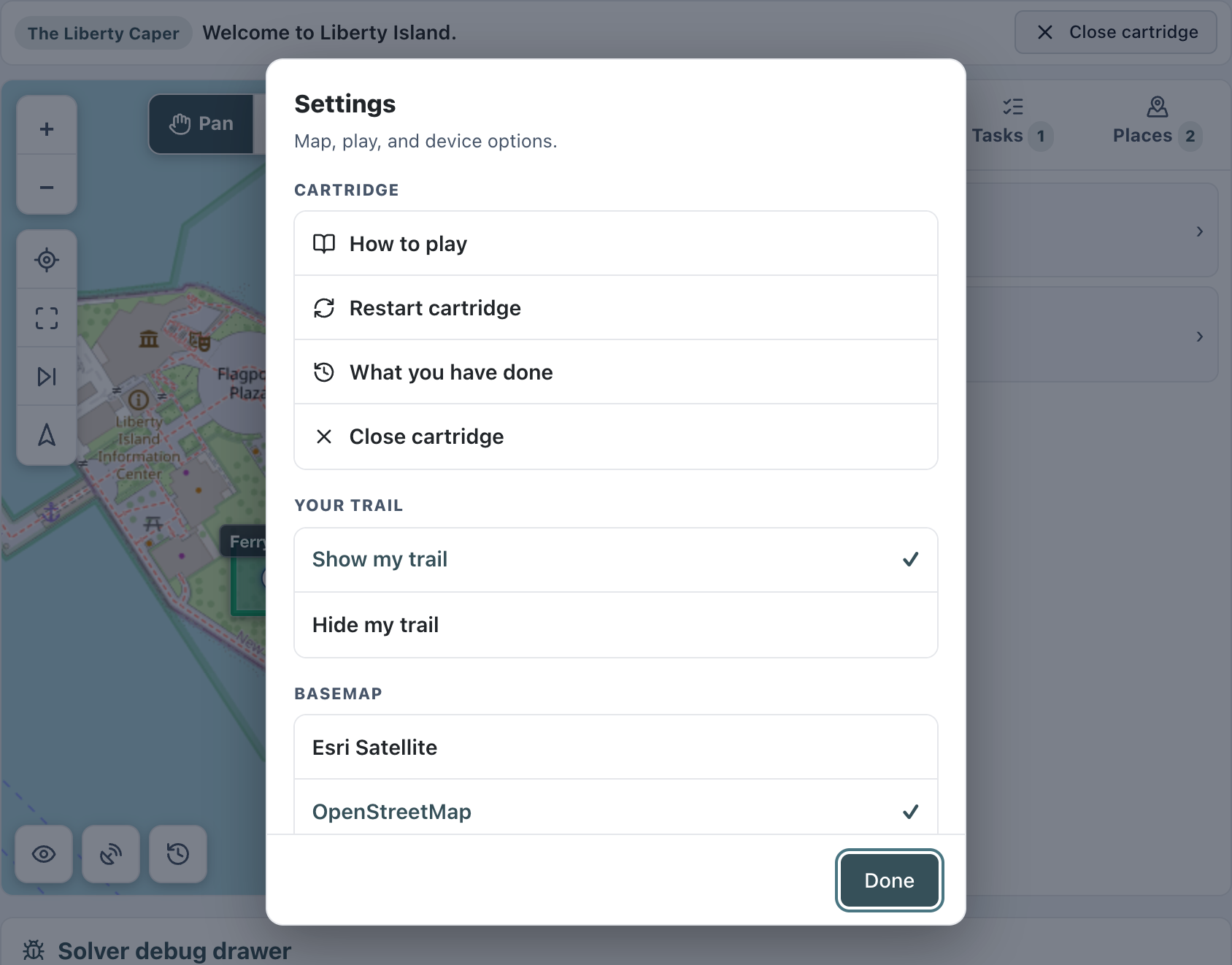
- How to play: this page, opened in a new tab, so you can read it without leaving the game.
- Restart cartridge: start the same game again from the beginning. It asks twice, because it throws away the walk you have done.
- What you have done: the same list the clock on the map opens, described below.
- Close cartridge, saving your progress on the way out.
- Your trail: show or hide the dashed line of where you have been.
- Basemap: OpenStreetMap, Esri Street, Esri Topo, OpenTopoMap or Esri Satellite. Satellite is the one that tells you whether a zone is on a path or in a hedge.
- Distance units: feet and miles, or meters and kilometers, or whatever your device already uses.
- Offline map: download the tiles around the cartridge before you go. It appears once a cartridge is running, since until then there is no area to fetch.
- Vibration: whether arrivals and messages buzz the phone. Only on a device that can actually vibrate.
Retracing your steps
Cartridges close places behind you. Once a stop is done its zone can switch off and disappear from the map, which is the author keeping you moving forward, but it does mean that after a few stops it is easy to lose track of what you have already done and who you have already spoken to.
- Tap the clock in the bottom left corner of the map. The status line under the cartridge name opens the same thing, and so does What you have done in Settings. The player lists everything you have done so far: where you arrived, what you picked up, what you finished and which questions you answered. Newest first, grouped by the place it happened in, and Escape or the close button puts it away.
- It records what you answered, word for word, next to the question. Plenty of cartridges never tell you whether an answer was accepted, on purpose, so this is often the only way to see that you typed a 6 where you meant a 9, or that you already tried the thing you are about to try again. It is kept on your device, in your own saved game.
- Go back one step. At the bottom of that list is a button naming the last thing you did that changed the cartridge, and it puts the game back to just before it: a task goes back to unfinished, an item leaves your pack, a zone that closed behind you opens again. It is one step, not a rewind of the whole walk, and it is only offered when that step really changed something. Walking somewhere is not undoable, since walking back out is the undo, and for the same reason the offer expires the moment you move on or arrive somewhere new: undoing a step you took two zones ago would put the game somewhere your feet are not.
- Your trail is the other half of the same question. The dashed line on the map is every spot you have stood in, so a stop you visited is still visible even after its zone has been switched off.
- Both are kept with your saved game, so they survive closing the app and coming back.
Progress, saving and finishing
- Your progress is saved as you play, on the device you played it on. Closing the tab, ejecting the cartridge or losing signal does not lose the game.
- Coming back, the Library offers to continue where you left off. A cartridge you have played is kept on the device, so it is one tap to resume.
- When a cartridge is finished it usually gives you a completion code. That is the code the cache page asks for, and the player shows it at the end. That card also offers Finish and eject: Close leaves the finished game up if you want to look around the map, and Finish puts the cartridge away.
- A cartridge that is stuck, or one you want to play again from the beginning, is Restart cartridge in Settings. It asks twice, and then the game starts over with nothing carried across.
Playing on more than one device
Everything above works with no account at all, and that is how Waypost runs unless you decide otherwise. If you want a walk you started on one device to be waiting on another, you can sign in to your CacheSleuth account, the same one My Puzzle Texts and the Cache Builder use.
- Where it is. The player's Account tab has a line telling you whether you are signed in, with a button next to it. During a game the same panel is under Account in Settings.
- Signing up happens on the website. The player signs in; if you do not have an account yet, the Create an account link opens cachesleuth.com, and on a phone that opens your browser rather than taking over the game.
- What moves. The cartridges you have played and the games you have saved, plus the name you type at the start of a cartridge. All of it is encrypted on your device before it is sent, so it cannot be read by anyone else, including us.
- What does not move. Your notes. Signing in here does not touch My Puzzle Texts.
- Room. An account keeps up to 20 cartridges or 50 MB, whichever comes first, and the least recently played file makes way when you go past it. Saved games are never removed to make room. If a cartridge file has aged out, load the .gwc again and your walk is still there, exactly where you left it.
- Two walks, one cartridge. If you played the same cartridge on both devices, the two cannot be merged, so Waypost asks you which one to keep rather than guessing.
- Signing out unlinks that device. Your cartridges and saves stay on it.
Solving rather than playing? The player has a debug drawer that shows the cartridge's live variables, zone states and distances. On a wide screen it is under the map, and on a phone it is inside Settings. The Wherigo Solver reads a .gwc without running it.